Blog · Business · May 24, 2011
Square Register – The First Step in Going After Visa and Mastercard.
Ever since Square started sending out free credit card readers people have wondered and speculated as to where the company would eventually go. Yesterday they announced Square Register, a free iPad-based POS system and CardCase,a virtual wallet product.
Square is attempting to create an alternate payment network to compete with Visa and Mastercard. Creating a new payments network is incredibly hard but, if successful, very lucrative and defensible. The hard part about creating a payment network is controlling both sides of the transaction – the customer and the store.
1. Register will become popular – existing POS systems are too expensive and complicated for most businesses.
Traditionally installing a new POS system is such a big project that it requires hiring outside consultants. Such projects can easily cost $10,000 or more of consulting time, in addition to the expensive license fees for the software itself.
For example, Intuit POS costs $999 for the starter edition (Pro is $1499) – And that product is simple and cheap relative to other POS companies… Though it locks you into Intuit merchant services, which are a very bad value (compared to rates that you’d get on FeeFighters)
The brokenness of the existing POS market bodes well for Register, and for all the other startups going after that market – including ERPly, CashierLive, Facecash, VendHQ, Shopkeep, Revel Systems, POSLavuand OwnPOS. It is not obvious that Square will win that battle, it is safe to say that Register will probably increase Square’s adoption among somewhat larger merchants than those that are currently using the Square app to accept payments.
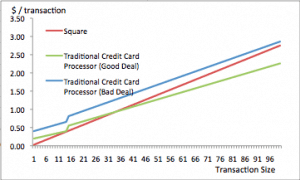
2. Square Currently Is Not Profitable on Small Transactions and is Expensive for Large Transactions
Credit card transactions typically have both a per-transaction and percentage fee. Since Square dropped its per-transaction fee it is actually losing money on small transactions even thought the overall rate of 2.75% sounds high
On larger transactions (and squares average transaction size is $83), they make good margin but are more expensive than a good deal on a traditional credit card processing account (but still cheaper than a bad deal with a traditional processor).
3. Register + CardCase = Aggregation and Internalization of Transactions
Credit card transactions have two parts- a per transaction part and a % part. For small transactions the per-transaction part is more significant. By combining several transactions into one transaction you can save a lot of money.
For example, consider what Apple does with iTunes. Rather than paying $0.10 per transaction (or more) to Visa and Mastercard every time I buy a $1 song, Apple saves up a few transactions and passes them through together. My favorite coffee shop should do this too – I typically buy three coffees / day so they could cut their transaction cost by 66% by combining the transactions from a single day, but they don’t.
Then Square can internalize transactions, which is basically how Paypal makes money. If Square can convince customers to fund a Square account using a low-cost transaction (like an ACH transfer from a bank account) they will lower their own cost of processing a payment dramatically, almost to zero.
4. Endgame – Compete with Visa and Mastercard
Once Square is internalizing transactions they are effectively a new payments network, in competition with Visa and Mastercard. Throughout history only a few payments networks have reached critical mass and the prize for doing so is huge.
There is additional upside if they can build additional features into payments. Credit card transactions haven’t really changed in 30 years and already Square is working on streamlining the order process, using other data for security (faces) and generating new business for its customers through the social features of CardCase.
More competition will be good for both businesses and consumers.
Fighting a chargeback, or paying too much?
The chargeback tool works with any processor. The statement audit is free.